








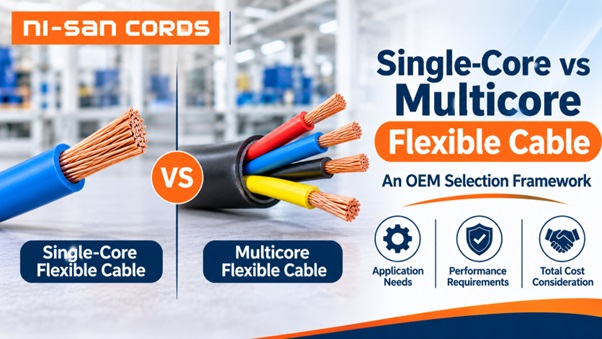
Single-core or multicore is not a choice you can settle by counting conductors. It changes how the wiring is pulled, terminated, tested and repaired. One multicore run may be quicker to install, yet awkward when its circuits branch in different directions. Separate wires may be easier to service but take longer to route. The better answer depends on the actual machine.
Begin with circuit architecture
Single-core wires give designers flexibility to route individual circuits, choose different conductor sizes and separate power, signal or protective conductors where required. They can work well inside panels and appliances when the wiring system provides suitable support, identification and protection.
Multicore cable groups several insulated conductors into one construction. It can simplify pulling, handling and cable identification between equipment sections, particularly where several circuits follow the same route. However, one overall cable may be less convenient when individual cores need to branch widely apart or have very different sizes.
Compare installation and termination labour
With single cores, installers may need more individual routing, tying, marking and handling. With multicore, they may gain a simpler pull but spend additional time preparing the outer sheath and separating cores. Measure the actual assembly cycle time, not only the cable price per metre.
The physical comparison should include gland size, enclosure entries, terminal compatibility and available bending space. A multicore cable may be too bulky for a small entry; several single cores may overcrowd a wiring channel. A manufacturer’s website can show broad product categories, but installation decisions need the finished dimensions and bending limits of the actual construction. Nominal conductor size alone is insufficient.
Electrical performance needs a full calculation
Conductor size and current-carrying capacity should be assessed under the real installation conditions. Grouping several loaded conductors can change thermal behaviour and may require derating. Long routes require voltage-drop calculations. Protection and earthing arrangements must follow the applicable design rules.
Where power and sensitive signals coexist, consider electromagnetic coupling, segregation and any shielding or grounding requirements. A multicore construction does not automatically solve interference, and individual wires do not automatically eliminate it. Circuit layout, return paths and installation practice matter.
Consider service and future changes
A single failed core in a multicore cable may require replacement of the entire cable run, depending on the application. With single cores, individual replacement may be easier in accessible panels but more difficult in long or congested routes. Multicore cable can make field identification straightforward when core numbering is stable and documented.
Future expansion also matters. Spare cores may be useful in a multicore run if they are allowed by the design and properly identified. But buying many unused conductors can add cost and diameter without practical value. Define expected service life and change scenarios.
Choose with a comparison matrix
A supplier shortlist for ‘Flexible wires & Cables manufacturers India‘ answers where to buy, not whether the equipment should use single-core or multicore cable. The route, branch points and terminations should be mapped before comparing prices. A multicore cable may save pulling time on a common run but take longer to terminate where cores split in different directions.
Compare gland entries, bend space, thermal grouping, maintenance access and assembly labour on the actual machine, not a catalogue diagram.
Questions about core configuration
Is multicore cable always cheaper? Not after installation labour, glands, termination time and future maintenance are counted. Compare the total installed cost for the same circuit requirements.
Are separate single cores always easier to bend? No. Compare the actual wire and cable constructions, diameters and stated bend limits.
Can power and signal conductors share a multicore cable? Sometimes, but only when the ratings, segregation, interference and system-design requirements allow it. Check the whole circuit arrangement rather than assuming one sheath makes the combination acceptable.